
Conveyance Devices and the Law: Where Your License Ends
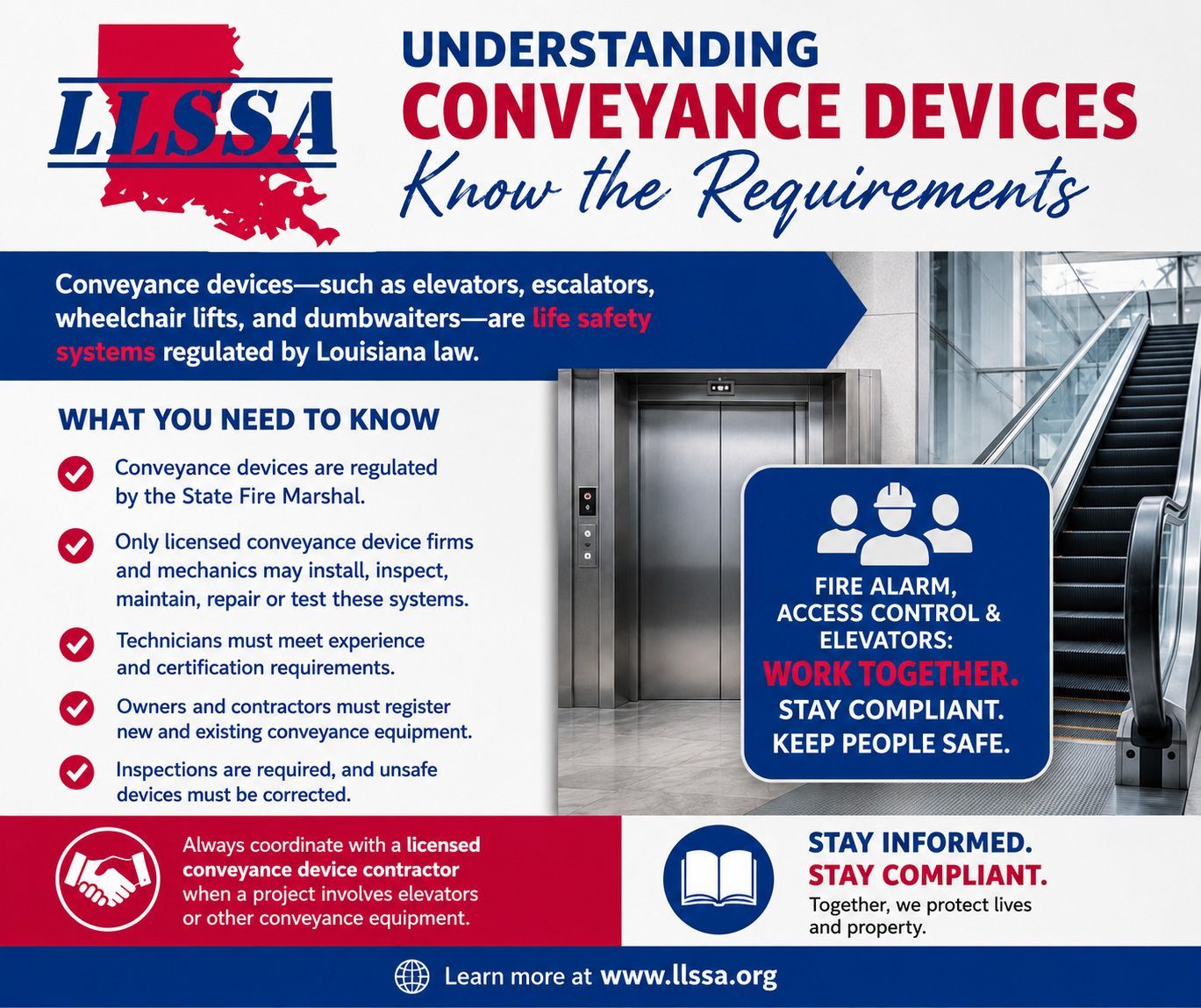
Most life safety and property protection contractors think of conveyance devices only when a fire alarm recall test or access control project involves an elevator. However, under Louisiana law, conveyance devices are a regulated part of the state's life safety framework, and understanding who can perform this work is just as important as understanding the licensing requirements for fire alarms, sprinklers, suppression systems, and security systems. The Louisiana Office of State Fire Marshal (OSFM) regulates conveyance devices through separate statutes and administrative rules, making it important for contractors to recognize where their own license authority ends and where a licensed conveyance contractor's responsibilities begin.
A conveyance device includes much more than a passenger elevator. Louisiana law defines these systems to include freight elevators, escalators, moving walks, dumbwaiters, wheelchair lifts, platform lifts, and other equipment designed to transport people or materials within a building. Because these systems directly affect occupant safety, especially during emergencies, they are regulated as life safety equipment and must be installed, maintained, inspected, and repaired in accordance with state law.
Unlike fire alarm or property protection endorsements issued under Chapters 30, 31, and 32 of the Louisiana Administrative Code, conveyance devices require their own licensing. A company holding a fire alarm, sprinkler, suppression, or security license is **not** automatically authorized to perform work on elevators or other conveyance equipment simply because those systems interface with their own. The Office of State Fire Marshal requires firms and individuals performing conveyance work to obtain the appropriate licenses before installing, altering, repairing, inspecting, maintaining, or testing these systems.
Louisiana also establishes minimum qualifications for licensed conveyance mechanics. Individuals must demonstrate substantial industry experience or complete nationally recognized training before becoming licensed. Current law allows applicants to qualify through extensive documented field experience or by combining work experience with recognized elevator industry education and certification programs. The State Fire Marshal may also issue temporary or emergency mechanic licenses when workforce shortages or emergency conditions exist, but these licenses are issued only under specific circumstances and remain tied to a licensed conveyance contractor.
Building owners also have responsibilities under Louisiana law. Conveyance devices must be properly registered with the Office of State Fire Marshal, and contractors installing new equipment are required to register the device within the time established by law. Before a new installation can be placed into service, it must undergo an acceptance inspection, with a licensed conveyance mechanic present during the inspection process. Existing equipment is also subject to periodic inspections, and if a conveyance device is found to be unsafe or out of compliance, the State Fire Marshal has the authority to require repairs or remove the equipment from service until deficiencies have been corrected.
Although many LLSSA members will never repair an elevator, they frequently work alongside them. Fire alarm contractors install elevator recall smoke detectors and shunt-trip circuits. Security contractors integrate access control with elevator controls. Special locking systems often depend on elevator lobby release functions required by NFPA 101. These projects require close coordination between licensed life safety contractors and licensed conveyance contractors. While your company is responsible for the installation, programming, and certification of the fire alarm or property protection systems within the scope of your license, any work involving the elevator machinery, controls, or conveyance equipment itself must be performed by the appropriately licensed conveyance professionals.
As Louisiana continues to modernize buildings with integrated life safety technologies, the relationship between fire alarm systems, access control, and conveyance devices will continue to grow. Understanding the licensing boundaries established by the Office of State Fire Marshal not only keeps your company compliant but also protects your customers and ensures every part of the building's life safety systems is installed and maintained by qualified professionals. When a project involves an elevator or other conveyance device, partnering with a licensed conveyance contractor is not simply a best practice—it is a requirement that helps preserve the safety of building occupants and the integrity of Louisiana's life safety industry.
Legal and Regulatory Disclaimer
Information provided by LLSSA is for educational and informational purposes only and should not be considered legal advice or the official position of any regulatory agency or organization. Users should independently verify all information with the appropriate authorities and consult qualified legal counsel or other professionals regarding their specific circumstances.