
News

Effective August 1, 2026, Louisiana businesses need to take a closer look at how they process debit-card payments. Act 751 of the 2026 Regular Legislative Session, formerly Senate Bill 254, prohibits a retail business from imposing a surcharge on a customer for using a debit card to purchase goods or services. For LLSSA members, this is an important compliance issue because the law broadly defines a retail business as a person or entity engaged in the sale of goods or services. That means life safety and property protection companies should review how customers are charged when paying invoices, service calls, installation charges, monitoring fees, equipment purchases, deposits, or other charges by debit card. A company may not think of itself as a traditional “retailer,” but if it sells goods or services and accepts debit-card payments, the language of Act 751 may apply. One of the biggest concerns may be payment-processing systems that were configured long before the new law took effect. Some processors and point-of-sale systems automatically add charges identified as a service fee, convenience fee, non-cash adjustment, or similar charge. A business owner may not have intentionally chosen to surcharge debit-card users, but an existing payment configuration could nevertheless result in an additional amount being imposed when a customer uses a debit card. The law defines a debit card as a card or other payment device that takes funds directly from the cardholder’s deposit account. This distinction is important. Businesses should not assume that choosing “credit” at a terminal automatically turns a debit card into a credit card. The key question under Act 751 is whether the payment device debits funds directly from the customer's deposit account. LLSSA members should therefore review more than the wording displayed on their payment terminals. Look at recent customer receipts and invoices and determine whether an additional fee is being added when a debit card is used. It may also be worthwhile to conduct a small test transaction using a debit card and compare the final amount charged with the original invoice or sale amount. Companies using online payment portals or recurring payment systems should review those systems as well. Act 751 also establishes protections and enforcement procedures when a violation occurs. Before bringing a private civil action, a cardholder must provide the business with written notice of the alleged violation. If the business corrects the violation and reimburses the cardholder for the surcharge within 30 days after receiving the written notice, no private right of action arises from that alleged violation. The private right of action applies to willful or repeated violations or violations that are not corrected within the specified period. The Louisiana Attorney General is also authorized to enforce the law, and violation of an administrative or court order issued under the law can result in a civil penalty of up to $500 per violation. The Attorney General is additionally required to maintain a toll-free telephone number and electronic reporting system through which consumers can report unlawful debit-card surcharges. Complaints can include documentation such as receipts or invoices showing the transaction and surcharge. This makes it particularly important for businesses to identify potential problems before customers do. For LLSSA members, the practical message is simple: check your payment-processing setup now. Do not assume your processor automatically changed an older configuration when Louisiana's new law became effective. Contact your merchant-services or payment-processing provider and specifically ask whether any surcharge, service fee, non-cash adjustment, or other additional charge can be applied to a debit-card transaction. If so, determine what changes are necessary to comply with Louisiana law. Members should also distinguish the new debit-card prohibition from their overall payment-pricing strategy. Act 751 specifically addresses surcharges imposed for the privilege of using a debit card. Businesses considering cash discounts, credit-card surcharges, convenience fees, or other pricing arrangements should verify that their practices comply with all applicable state law, federal requirements, and payment-network rules rather than assuming that a program that was acceptable in the past remains compliant. A one-minute review of a few receipts and a conversation with your payment processor could prevent a much larger compliance problem later. Louisiana's debit-card surcharge law is already in effect, making now the time for life safety and property protection companies to understand exactly what their customers are being charged. Members can review Act 751 (SB 254) directly through the Louisiana Legislature for the complete statutory language. This article is provided for general informational purposes only and should not be considered legal advice. Businesses with questions about how Act 751 applies to their specific payment practices should consult qualified legal counsel or their payment-processing compliance professional.

The Louisiana Life Safety & Security Association (LLSSA) is gearing up for its 2026 Convention & Tradeshow, bringing Louisiana’s life safety and property protection industry together for education, networking, industry updates, and the opportunity to see the latest products and technology. This year’s convention will be held November 19, 2026, at the Hilton New Orleans Airport in Kenner, Louisiana, with the annual LLSSA Golf Tournament kicking off the activities one day earlier. The festivities begin Wednesday, November 18, with the annual LLSSA Golf Tournament at Riverlands Golf & Country Club, 500 Fairway Drive in LaPlace. Registration begins at 9:30 a.m., followed by a Putting Contest at 10:00 a.m. and tournament play at 11:00 a.m. The day concludes with awards and a social beginning at 3:30 p.m. More than just a day on the course, the tournament supports the LLSSA Youth Scholarship Program, helping LLSSA give back to the families of Louisiana’s public safety professionals. On Thursday, November 19, attention turns to the Hilton New Orleans Airport for a full day of convention activities from 8:00 a.m. to 5:00 p.m. Attendees can earn up to 7 continuing education units (CEUs) while participating in educational sessions that include classes presented by industry professionals and the Louisiana State Fire Marshal’s Office. The day will also include the LLSSA State Meeting, providing important updates affecting Louisiana’s life safety and property protection industry. A major highlight of the convention will be the Tradeshow featuring approximately 70 vendors. Attendees will have the opportunity to meet manufacturers, distributors, monitoring centers, service providers, and other industry partners while exploring new products, technology, services, and resources. The tradeshow creates an opportunity to make valuable connections and learn about solutions that can help Louisiana companies strengthen and grow their businesses. The Hilton New Orleans Airport, 901 Airline Drive in Kenner, will serve as the convention headquarters. A special LLSSA hotel group rate is available using group code LLSSA, making it convenient for attendees and exhibitors to stay where the convention activities are taking place. Registration is required for the convention, and both attendee and vendor registration options are available through LLSSA. The LLSSA Convention continues to be one of the association’s most important opportunities to bring together installers, technicians, company owners, manufacturers, distributors, monitoring professionals, regulators, and other industry partners. From continuing education and regulatory information to networking and discovering new technology, the 2026 event is designed to provide practical value to professionals throughout Louisiana’s life safety and property protection industry. Mark your calendar for November 18–19, 2026, and make plans to join LLSSA for two days of golf, education, industry updates, networking, and the tradeshow. Convention Committee Chair Karen Shall may be contacted at 631-786-5224 for convention information, while Golf Chair Donald McLaren may be contacted at 504-231-0353 for golf tournament information.

For decades, the life safety and property protection industry has largely been built around a familiar business model: sell the equipment, install the system, provide monitoring when applicable, and respond when the customer needs service. That model is changing. Technology, cloud connectivity and changing customer expectations are pushing integrators toward a relationship in which the installation is increasingly the beginning—not the end—of the opportunity. The shift is toward services and outcomes. Customers may care less about the model number printed on a piece of equipment than they do about what the overall system can accomplish. Can they manage multiple locations remotely? Can they receive useful information instead of simply an alarm notification? Can their security, video and access control systems work together? Can problems be identified before they result in downtime? These are increasingly the questions that can influence purchasing decisions. For Louisiana life safety and property protection companies, that creates an opportunity to rethink how systems are sold. A traditional proposal may concentrate heavily on equipment, quantities and installation costs. A service-focused approach begins with the customer's problem and demonstrates how the proposed system can address it. The technology is still important, but the conversation becomes less about comparing one device with another and more about demonstrating the value the entire solution can provide. That change can also create opportunities for recurring revenue. Cloud-based platforms, remote system management, video services, access management and other ongoing offerings can allow an integrator to maintain a continuing relationship with a customer rather than waiting until equipment fails or the customer needs another installation. Recurring services can provide value to customers while helping integrators build more predictable revenue and stronger long-term relationships. Service departments may experience an equally significant change. Traditionally, service has often been reactive: something stops working, the customer calls, and a technician is dispatched. Connected systems can increasingly provide information that helps a company recognize certain problems before the customer does. Depending on the system and issue, personnel may be able to diagnose a problem remotely, determine what equipment or expertise will be needed before dispatching a technician, or sometimes correct the problem without a truck roll. This proactive approach can change the customer's perception of service. Instead of calling because something is already wrong, customers may hear from their provider first. A company that can tell a customer, "We identified an issue with your system and are working to address it," can create a very different customer experience from one that waits for the customer to discover the problem. Data is becoming an important part of that relationship as well. Connected systems can provide integrators with information about system performance and how customers are using available features. That information may help identify systems that need attention, customers who could benefit from additional training, or capabilities that are available but are not being fully utilized. The goal should not simply be to sell another product. It should be to help customers receive greater value from systems they already depend upon. Artificial intelligence is likely to accelerate this transition. AI tools are beginning to offer opportunities throughout sales, service and business operations. They can assist with analyzing information, developing more customer-focused proposals, identifying patterns in system data and helping employees determine where attention may be needed. As these tools mature, they could allow integrators to accomplish more with existing staff while providing customers with increasingly personalized service. However, technology alone does not create a successful service business. Moving toward managed services may require companies to reconsider employee training, sales processes, customer communication and internal responsibilities. Salespeople need to understand how to explain outcomes rather than simply features. Technicians may need stronger networking, software and troubleshooting skills. Office and service personnel may need processes for reviewing system information and proactively communicating with customers. For life safety systems, this evolution must also remain grounded in code, licensing requirements, manufacturer instructions and applicable Louisiana State Fire Marshal rules. Remote capabilities and new technology do not eliminate an integrator's responsibility to perform required inspections, testing, maintenance, documentation or licensed work correctly. Technology should strengthen professional service—not become a substitute for regulatory compliance or properly trained personnel. There is also an important competitive consideration. As customers become accustomed to cloud-connected systems and ongoing services, the relationship between the customer and integrator may become deeper. A provider that understands the customer's facilities, users, operating procedures and security needs can become much more than the company that installed the equipment. It can become a trusted technology and life safety partner. That may be one of the most important lessons for Louisiana integrators. The industry's future is not necessarily about installing fewer systems. It is about recognizing that the value of an installation can continue long after the technician leaves the jobsite. Companies that combine professional installation with proactive service, recurring solutions, knowledgeable employees and strong customer relationships will be positioned to compete in an increasingly service-driven marketplace. The equipment will always matter—but the value an integrator provides between installations may increasingly be what keeps the customer. Source: Security Systems News, “The Integrator Reset: Services Take Center Stage,” May 20, 2026.

For Louisiana contractors, titles such as “foreman,” “apprentice,” and “technician” can sound like different steps on the same licensing ladder. Under Louisiana’s Life Safety and Property Protection laws and administrative rules, however, they do not all mean the same thing, and the term foreman has a specific application in the fire sprinkler rules. Understanding these distinctions is important when assigning employees to jobs, deciding who can perform or certify work, and planning employee training. Louisiana’s fire sprinkler rules define a foreman as an employee designated by a sprinkler firm who certifies an installation or service work, completes an acceptance test, or identifies impairments of fire sprinkler equipment or systems. The rules separately define an inspector as a licensed individual who certifies, inspects, or performs hydrostatic testing. They also state that, for purposes of the sprinkler rules, qualifiers, inspectors and foremen are considered sprinkler firm employees. That distinction matters because a sprinkler foreman is allowed to perform responsibilities that should not be confused with those of a licensed sprinkler inspector. The tagging provisions make the division particularly clear. A foreman may place a tag for an installation, service, acceptance testing or an impairment, but may not perform the annual certification. An inspector, by comparison, may tag an installation, annual certification, service or impairment, but may not perform acceptance testing. A qualifier may tag installations, service, acceptance testing and impairments, but not annual certifications. What Training Does a Foreman Need? This is an area where contractors should be careful not to read a requirement into the rules that is not actually there. Chapter 31 establishes specific initial certification and continuing-education requirements for qualifiers and inspectors. It does not establish a separate State Fire Marshal foreman license or a specific initial certification course for someone simply because the sprinkler firm designates that employee as its foreman. The fee schedule likewise lists employee licenses for qualifiers and inspectors, rather than a separate foreman license. That does not mean a foreman can be untrained. Fire sprinkler work must be performed in accordance with the applicable NFPA standards adopted by the State Fire Marshal, and the certified sprinkler firm must operate under a qualifying person who is primarily and actively engaged in the direct supervision of the firm's sprinkler activities. The rules also authorize the State Fire Marshal to require a firm or its employees to demonstrate proficiency with the equipment necessary to perform regulated sprinkler work. If proficiency cannot be demonstrated, additional training can be required. In practical terms, a company should not treat “foreman” as simply a job title given to the most experienced person on a crew. A foreman is taking responsibility for regulated sprinkler work, including certifying installation or service work, completing acceptance testing and identifying impairments. The firm should make certain that the individual has the knowledge, training and experience necessary to carry out those responsibilities in accordance with the approved plans, applicable NFPA requirements and the State Fire Marshal's rules. What About an Apprentice? This is where an important distinction needs to be made. The apprentice endorsement found elsewhere in Louisiana's Life Safety and Property Protection rules should not be confused with the fire sprinkler foreman designation under Chapter 31. Louisiana law generally defines an apprentice as a person licensed to work under the direct supervision and accompaniment of a technician who is licensed to the same firm and holds a valid license to perform the same acts. The law further provides that an apprentice performing regulated work must apply for an apprentice license and may perform those services only under the direct supervision of a properly licensed technician working for the same firm. For the work regulated under Chapter 30, which includes fire alarm, fixed fire suppression, portable fire extinguishers/fire hoses and related activities, the apprentice endorsement allows an individual to inspect, install, maintain and service the covered equipment only while directly supervised and accompanied by an appropriately licensed technician. An apprentice cannot certify the fire protection system or equipment. One of the most important points for employers is that there is no maximum number of years an individual may hold that apprentice endorsement under the Chapter 30 rule provided. The rule specifically states that the apprentice endorsement “can be renewed annually as long as the individual or firm desires.” In other words, the rules reviewed here do not require a Chapter 30 apprentice to become a technician after one, two, three or any other specified number of years. There is also no competency examination required simply to obtain the Chapter 30 apprentice endorsement. Once an individual is ready to move from apprentice to technician, however, the technician application must include documentation showing that the applicant has met the competency requirements established by the Life Safety and Property Protection Advisory Board. Current education guidelines require technician and specialist applicants to complete approved training for the endorsement being sought, including an examination with a pass/fail result, and to provide the appropriate training certificate with the initial license application. The Key Point for Louisiana Contractors A fire sprinkler foreman is not simply an apprentice waiting to become a technician. Foreman is a specific role recognized under Louisiana's Chapter 31 fire sprinkler rules. The foreman can certify sprinkler installation and service work, complete acceptance testing and identify impairments, but cannot perform the annual certification reserved for a licensed inspector. By contrast, an apprentice working under the applicable apprentice provisions must remain under the direct supervision of an appropriately licensed technician and cannot independently certify regulated systems or equipment. For Louisiana life safety and property protection firms, the safest approach is to look beyond the employee's company job title and ask: What work is this person actually performing, what chapter regulates that work, and what license, designation or supervision does that work require? Making that distinction before sending an employee into the field can help prevent licensing violations while also giving employees a clear path toward the training and credentials needed to take on greater responsibility.

The Louisiana Life Safety & Security Association (LLSSA) is proud to announce that applications are now being accepted for the 2027 LLSSA Youth Scholarship Program, continuing the association’s longstanding commitment to supporting the families of Louisiana’s police, fire, and emergency medical services professionals. The Youth Scholarship Program was established to promote goodwill and strengthen the relationship between the electronic systems industry and the police, fire, and EMS officials who work every day to protect Louisiana’s communities. Through the program, LLSSA provides college scholarship awards to deserving sons and daughters of these public safety professionals. Over the years, thousands of dollars in scholarships have been awarded to students attending higher education institutions in Louisiana. For the 2027 program, eligible students have an opportunity to be recognized not only for their academic accomplishments, but also for their involvement outside the classroom and their understanding of the important role their parent or guardian plays in keeping their community safe. Scholarship recipients are selected based on a combination of academic achievement, national test scores, extracurricular participation, and an essay. As part of the application, each student must submit the required documentation and write an essay addressing the topic: “What it means to me to have my parent or guardian involved in securing our community.” That essay gives applicants an opportunity to share a perspective that grades and test scores alone cannot capture. Children of police officers, firefighters, and EMS personnel often see firsthand the dedication required of those who serve the public. The scholarship program recognizes those families while helping deserving students take the next step toward their own futures. The deadline to apply for the 2027 LLSSA Youth Scholarship is March 1, 2027. Students and families are encouraged to begin the process early so there is plenty of time to complete the application, gather the necessary documentation, and prepare the required essay. Applications may be submitted by email to director@llssa.org or mailed to LLSSA, Post Office Box 7, Livingston, LA 70754. Questions about the scholarship program or application process may be directed to LLSSA at 337-886-7282. LLSSA encourages its members, alarm and life safety companies, public safety agencies, schools, and community partners throughout Louisiana to help spread the word. If you know a qualifying high school senior whose parent or guardian serves in police, fire, or EMS, please make sure their family knows about this opportunity. Supporting public safety means supporting the people who serve as well as the families who stand behind them. The LLSSA Youth Scholarship Program is one way our industry can recognize that service while investing in the education and future of Louisiana’s next generation. Applications must be received by March 1, 2027. View eligibility information and download the 2027 application on the LLSSA Youth Scholarship Program page https://www.llssa.org/scholarships

Technology is changing the life safety and property protection industry at a remarkable pace. Artificial intelligence, advanced video analytics, cloud-based platforms, remote services, automated detection and increasingly connected systems are giving security professionals capabilities that would have seemed impossible only a few years ago. But as these technologies become more powerful, one thing is becoming increasingly clear: the future of our industry is not about choosing between skilled people and advanced technology. It is about bringing the two together. For Louisiana alarm dealers, technicians and integrators, that distinction is important. Customers may hear about the newest AI-enabled camera, automated access control platform or intelligent detection system and assume technology can solve nearly every security problem. In reality, even the most sophisticated equipment is only part of an effective solution. Technology can identify patterns, process enormous amounts of information and alert operators to conditions requiring attention, but trained professionals must still determine how that technology should be designed, installed, programmed, maintained and used. That begins with understanding the customer's actual risk. Too often, security conversations begin with a product rather than a problem. A customer asks for cameras, access control, an intrusion system or another specific technology because that is what they believe they need. The professional integrator's job is to look beyond the equipment and ask what the customer is actually trying to accomplish. What are they protecting? Where are their vulnerabilities? What happens when an alarm occurs? Who needs to receive information, and what action should follow? Those questions become even more important as systems grow increasingly interconnected. Cameras may communicate with access control systems. Video analytics can help identify activity before a traditional alarm occurs. Remote services can allow technicians or monitoring personnel to evaluate conditions without immediately dispatching someone to a property. Artificial intelligence can help sort through information that would otherwise require significant human effort. Used properly, these technologies can make security professionals more effective rather than simply replacing the work they perform. That creates an opportunity for Louisiana companies willing to invest in both equipment and employees. The technician of the future will need more than the ability to mount a device, terminate wires and program a panel. Understanding networking, cybersecurity, communications technology, software, analytics and system integration is becoming increasingly valuable. At the same time, traditional skills remain essential. Knowing applicable codes and standards, understanding proper installation practices, recognizing potential hazards and communicating effectively with customers cannot be automated away. Human judgment remains particularly important in life safety applications. Technology can provide information, but someone must understand what that information means and how it should be applied. A system that technically functions may still fail to meet a customer's actual needs if it was poorly designed, incorrectly configured or inadequately explained to the people who use it. This also changes how companies should think about training. Continuing education cannot simply be viewed as something required to maintain a license. As technology advances, training becomes an important business investment. Companies that continually develop their technicians will be better prepared to install emerging technologies, troubleshoot increasingly complex systems and explain those systems to customers. That expertise can become a competitive advantage. The same principle applies to sales. Competing primarily on equipment and price becomes increasingly difficult when customers can research products online and compare specifications in seconds. Professional knowledge is harder to duplicate. Companies that understand a customer's risks and can recommend an appropriate combination of technology, monitoring, service and human response offer something far more valuable than a box of equipment. There is also a danger in adopting technology simply because it is new. Not every new product or artificial intelligence feature belongs in every application. Technology should solve a defined problem, improve performance, reduce risk or make an existing process more effective. Installers and integrators should evaluate new solutions based on what they accomplish for the customer rather than how impressive the technology sounds. The companies that succeed over the next decade may not necessarily be those with the most technology. They will be the companies that know how to use technology intelligently. They will invest in trained technicians, knowledgeable salespeople and capable service personnel while giving those employees better tools to perform their jobs. Louisiana's life safety and property protection industry has always depended on skilled professionals. Technology is changing the tools those professionals use, but it is not eliminating the need for their expertise. In many ways, it is making that expertise even more valuable. The future is not people versus technology. It is knowledgeable people using better technology to design better systems, make better decisions and provide better protection for the Louisiana homes, businesses and communities that depend on them.
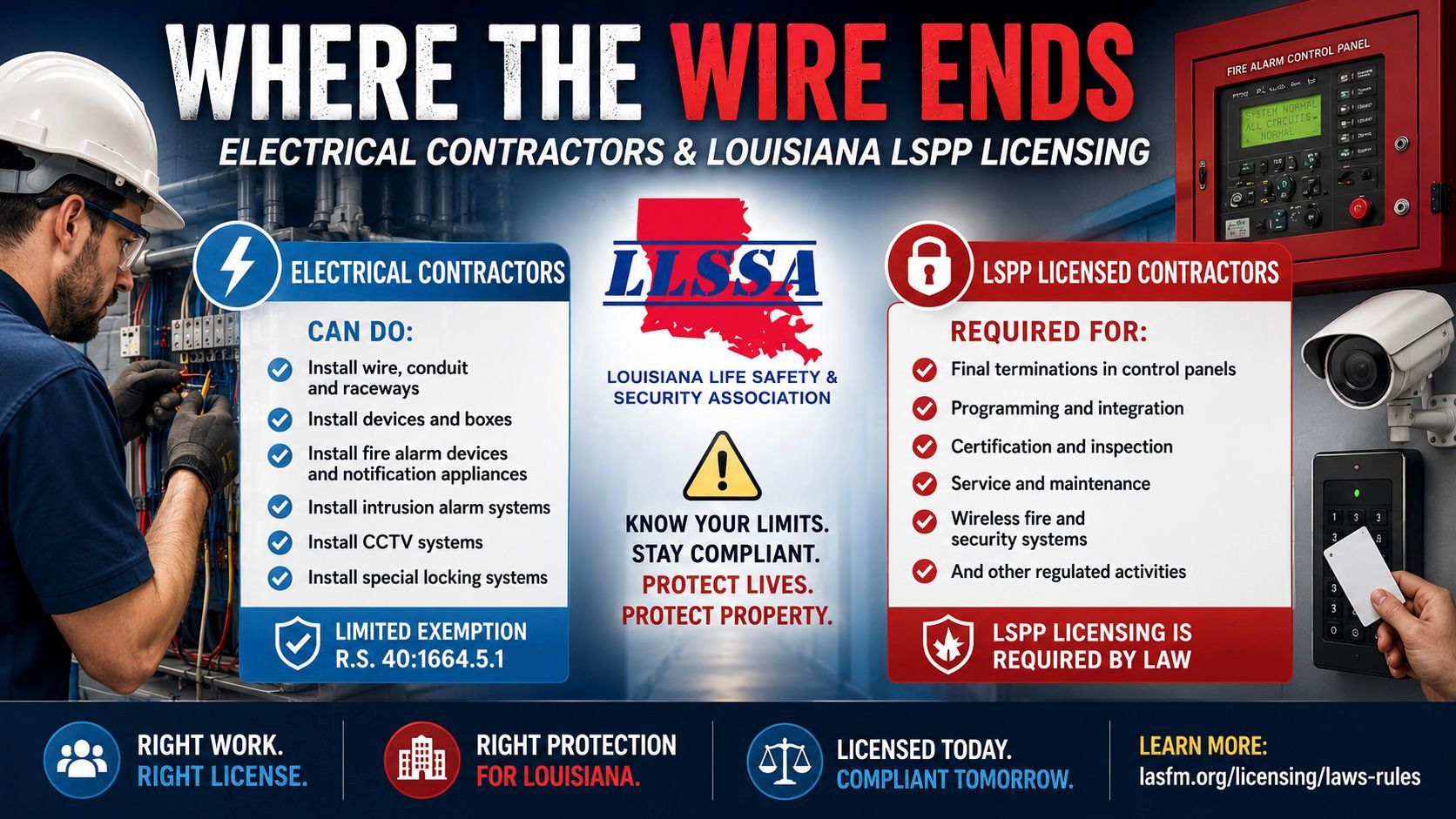
Electrical contractors and life safety and property protection contractors often work side by side on the same project. A fire alarm system needs wiring. A security system needs power and cabling. Access control and special locking systems involve electrical components. Cameras require cabling and connections. Because the work overlaps, it can be easy to assume that an electrical contractor's license automatically authorizes the contractor to perform every part of these systems. Louisiana law draws a much more specific line between electrical work and licensed Life Safety and Property Protection (LSPP) work. Understanding that line is important for electrical contractors as well as fire alarm, security, access control and CCTV companies that may be working with them on the same project. The starting point is Louisiana Revised Statute 40:1664.5.1, which establishes a **limited exemption from LSPP licensure for electrical contractors**. The statute applies to a firm or person holding the classification of **Electrical Work (Statewide)** through the Louisiana State Licensing Board for Contractors. Under that exemption, the electrical contractor may install wire, conduit and other wire raceways, associated boxes and fittings, as well as certain devices and systems, without obtaining an LSPP license from the Louisiana State Fire Marshal. The systems covered by the exemption include fire alarm initiating and notification devices, intrusion alarm systems, closed circuit television systems and special locking systems in commercial or residential property. In practical terms, a properly licensed statewide electrical contractor can perform a significant amount of the physical installation associated with these systems. However, the exemption does not turn the electrical contractor into a licensed fire alarm, security, CCTV or special locking contractor. One of the most important limitations concerns **final termination**. R.S. 40:1664.5.1 specifically states that the electrical contractor's exempt work does not include final termination in a fire alarm control panel, security control panel, access control panel or CCTV system controls. Those final terminations must be performed by a firm and an individual holding the appropriate valid LSPP licenses. This distinction is especially important on fire alarm projects. Chapter 30 of the Louisiana Administrative Code similarly states that electrical contractors are limited to installation of wiring, conduit raceways and/or devices for fire detection and alarm systems, while connections or final terminations within the alarm control panel must be made by licensed employees of the fire detection and alarm firm. The rules also reserve certifying, inspecting, integrating, maintaining and servicing a fire detection and alarm system to properly certified fire alarm firms and their licensed employees. The law places another clear restriction on electrical contractors: **they may not certify, inspect or service life safety and property protection systems or equipment under the electrical-contractor exemption.** Those activities require the appropriate LSPP licensing. This means that completing physical installation work that falls within the exemption is different from assuming responsibility for the completed system, inspecting it for compliance, certifying it or returning later to perform service work. Wireless systems are another important limitation. The statute expressly says that the electrical-contractor exemption does **not** apply to a person or entity selling, installing, servicing or maintaining wireless security and fire systems. An electrical license should therefore not be viewed as a general authorization to enter the wireless alarm business without the applicable LSPP credentials. Special locking systems deserve particular attention because they affect building egress and life safety. Chapter 32 requires plans for applicable new or renovated special locking systems to be submitted to and reviewed by the State Fire Marshal before installation. The rules also provide that the completed system must be certified by a property protection contractor, and an electrical contractor is not permitted to certify, inspect or service the special locking system. The plan-review requirements can also affect when work begins. Chapter 32 provides that when a special locking system requires plan submittal, system locks, devices and panels cannot be installed before the required review or written authorization. Wiring-only work may begin after plans have been received and a project review number has been issued, as provided by the rule. Fire sprinkler systems present another boundary. The electrical-contractor exemption in R.S. 40:1664.5.1 does not provide authority to perform fire sprinkler contracting. Chapter 31 requires regulated sprinkler work to be performed within the applicable sprinkler licensing requirements. It also specifically addresses alarm devices associated with sprinkler piping: devices such as flow switches, pressure switches and low-air-pressure switches that are integral to the piping system are installed by the certified fire sprinkler contractor and connected to the fire alarm system by a certified fire detection and alarm firm. The licensing question therefore depends not simply on whether electricity is involved, but on **what activity is actually being performed**. Louisiana law defines life safety and property protection contracting broadly to include certification, inspection, installation, integration, programming, sale and service of systems designed to protect life and property. It also encompasses activities such as prewiring, construction, maintenance, repair, testing, modification and alteration. The electrical-contractor exemption carves out specific installation activities from those requirements; it does not remove the remainder of the LSPP law. This is also why an electrical contractor that wants to go beyond the limited exemption needs to look at LSPP licensing separately. If a company intends to perform activities requiring an LSPP license—such as final control-panel terminations, certification, inspection or service—it must obtain the applicable firm licensing and endorsements and use appropriately licensed personnel. Louisiana law requires a firm engaged in LSPP contracting to obtain a license for each operating location and for each discipline in which it performs regulated work. Among the firm requirements are appropriate insurance and employment of a qualifying individual with the required certification and training for each endorsement held. There is one point contractors should be particularly careful about when reading the regulations online. Some provisions of Chapters 30 and 32 were written before the current statutory limited exemption and contain language describing electrical-contractor authority somewhat differently. The State Fire Marshal's own Laws & Rules page currently cautions that the regulations posted there are under review and revision and may not be current, and directs licensing questions to the Licensing Division for clarification. ([Louisiana Office of State Fire Marshal][1]) Contractors should therefore review the current statute—particularly R.S. 40:1664.5.1—along with the applicable administrative rule rather than relying on one provision in isolation. For installers, the safest way to think about the distinction is straightforward: **an electrical license and an LSPP license authorize different scopes of work.** A qualifying statewide electrical contractor has a limited statutory exemption that allows specified installation work on certain life safety and property protection systems. It does not provide blanket authority to perform everything associated with those systems. Final control-panel terminations, certification, inspection, service and other regulated activities remain within the appropriately licensed LSPP disciplines, and wireless fire and security systems are specifically outside the electrical-contractor exemption. Before accepting a project that approaches the boundary between electrical and LSPP work, contractors should identify exactly who will install the equipment, who will make the final control-panel terminations, who will perform any required programming or integration, and who will inspect, service and certify the finished system. Establishing those responsibilities before work begins can prevent licensing problems, project delays and disputes at final inspection. The Louisiana Office of State Fire Marshal maintains the applicable statutes and administrative rules on its [Life Safety and Property Protection Laws & Rules page](https://www.lasfm.org/licensing/laws-rules/?utm_source=chatgpt.com). Because the State Fire Marshal notes that some posted regulations are currently under review and revision, contractors with questions about whether a particular task falls within the electrical-contractor exemption should contact the OSFM Licensing Division for clarification before performing the work.
The video surveillance industry is entering a period of significant growth, and for Louisiana’s life safety and property protection professionals, that growth represents much more than an increase in camera sales. The global video surveillance market, valued at approximately $83.5 billion in 2025, is projected to reach nearly $204.7 billion by 2033, representing an annual growth rate of about 11.7 percent. For installers and integrators, those numbers point toward expanding opportunities—but also a changing definition of what customers will expect from a professionally installed surveillance system. Much of this growth is being driven by the transition from traditional video recording to intelligent, connected security. Artificial intelligence, deep learning, cloud services, Internet of Things technology and advanced video analytics are allowing cameras to do far more than simply capture footage. Systems can increasingly identify people, vehicles and objects, recognize unusual activity, generate real-time alerts and help security personnel focus their attention on events that may actually require action. Separate market research estimates that the AI portion of the video surveillance market alone could grow from approximately $4.04 billion in 2026 to $10.88 billion by 2032. For Louisiana installers, this evolution creates an opportunity to move the customer conversation away from simply asking, “How many cameras do you need?” The better questions involve what the customer wants the system to accomplish. Does a business need perimeter protection after hours? Does a warehouse want to identify people or vehicles entering restricted areas? Does a retail customer want better incident verification? Does a commercial property need video integrated with access control, intrusion detection or remote monitoring? As surveillance technology becomes more intelligent, system design increasingly begins with the customer's desired outcome rather than the camera count. IP-based systems are already leading the market, accounting for more than half of video surveillance system revenue in 2025. Hardware remains the largest component of the overall market, but services are expected to grow as customers require professionals who can properly install, configure and maintain increasingly complex systems. That is particularly important for professional integrators because cameras are becoming part of a larger technology ecosystem involving networks, software, cloud platforms, mobile applications, analytics and other security systems. This change also means installers must become increasingly comfortable with networking and cybersecurity. A modern IP camera is not simply a security device mounted to a building; it is a network-connected endpoint. Poor passwords, outdated firmware, improper network configuration, unnecessary remote access or unsecured devices can create vulnerabilities for the customer. As more surveillance systems connect to cloud platforms and other building systems, cybersecurity should be considered during system design, installation and ongoing service—not after a problem occurs. Artificial intelligence also requires installers to understand the limitations of the technology they sell. A system advertised as capable of detecting people, vehicles or unusual activity still depends heavily on camera placement, lighting, field of view, resolution, environmental conditions and proper configuration. Installers should avoid overselling analytics as a replacement for sound system design. AI can make surveillance significantly more useful, but it cannot compensate for a poorly positioned camera or an improperly configured system. The growth of video analytics also brings privacy and data-management considerations. Features such as facial recognition, license plate recognition, behavioral analysis and cloud video storage can create questions about how information is collected, stored, accessed and retained. Installers should understand the capabilities of the products they offer and clearly communicate those capabilities to customers. Contracts, system documentation and customer policies should also accurately reflect the services being provided and the responsibilities of the parties involved. Recurring services may become one of the most important opportunities created by this expanding market. Cloud video storage, remote system management, health monitoring, analytics subscriptions, software licensing, cybersecurity maintenance and integration with professional monitoring can turn a one-time installation into an ongoing customer relationship. Instead of competing primarily on the price of cameras and recorders, companies can build value around system performance, service and long-term support. The commercial market is particularly important, accounting for the largest share of video surveillance revenue in 2025. Louisiana integrators serving businesses, industrial facilities, schools, healthcare properties, multifamily developments and other commercial customers should pay close attention to how these organizations are changing their expectations. Customers increasingly want systems that provide useful information quickly rather than hours of recorded video that someone must manually review after an incident. A market approaching $204 billion does not guarantee success for every security company. It does, however, demonstrate that video surveillance is becoming an increasingly important part of the overall security environment. The companies positioned to benefit will be those that continue educating their technicians, strengthen their networking and cybersecurity knowledge, understand emerging analytics and build solutions around the customer's actual security needs. For Louisiana’s life safety and property protection industry, the message is clear: video surveillance is no longer just about putting cameras on walls. It is becoming an interconnected security platform combining video, data, analytics, communications and professional services. Installers who develop the skills necessary to design, install, secure and support these systems will be positioned to participate in one of the fastest-growing areas of the security industry.

For Louisiana life safety and property protection companies, bringing a new employee into the field involves more than simply pairing that person with an experienced installer. Louisiana law recognizes an apprentice as a licensed individual with a specific role, specific limitations, and a very important supervision requirement. Understanding those rules helps companies train new employees while remaining compliant with the Office of State Fire Marshal (OSFM). Under the Louisiana Life Safety and Property Protection Licensing Act, an apprentice is defined as a person licensed to work under the direct supervision and accompaniment of a technician who is licensed to the same firm and holds a valid license to perform the same acts. Louisiana's rules further explain that direct supervision means onsite supervision by a properly licensed technician or specialist. The supervising technician can supervise the apprentice only in areas in which that technician is licensed, and both individuals must be licensed to the same firm. This is an important distinction for employers. An apprentice license is not permission to send an inexperienced employee into the field independently. The apprentice is there to learn and gain practical experience while working alongside someone who already holds the proper license. In fact, working an apprentice without the required direct supervision of a technician licensed for the work being performed and licensed to the same firm is classified as a serious offense under the rules. For property protection work, the rules specifically require employees, including apprentices, to obtain the appropriate license before conducting regulated property protection activity. The apprentice endorsement authorizes the employee to engage in property protection activity while under the direct supervision of a technician licensed to the same firm who holds a valid license to perform the same acts. This means the scope of what an apprentice can learn and perform is tied directly to the credentials of the technician supervising that apprentice and the endorsements held by the company. The rules are particularly helpful in answering a common question from employers: What training must someone complete before becoming an apprentice? Under Chapter 32's application requirements for property protection licenses, no competency examination or training is required for an apprentice. The employer still applies for the individual's license, and the apprentice must be properly licensed before performing regulated work. The apprentice classification is therefore designed to provide an entry point into the industry where the employee can receive practical, supervised experience before completing the training and certification required for a technician or specialist endorsement. For fire protection work regulated under Chapter 30, the apprentice's authority is also clearly limited. An apprentice may inspect, install, maintain, and service portable fire extinguishers, fire hoses, fixed fire suppression systems, and fire detection and alarm systems or equipment, but only while under the direct supervision of and accompanied by a properly licensed technician. Most importantly, an apprentice cannot certify fire protection systems or equipment. That distinction should matter to every company using apprentices. An apprentice may be gaining hands-on experience performing installation and service tasks, but the apprentice has not become the licensed technician responsible for independently performing and certifying the work. Companies should make sure their dispatching and scheduling practices reflect that limitation. Sending an apprentice to a service call alone simply because the employee has become familiar with the equipment does not satisfy the direct-supervision requirement. There is also an important misconception about how long someone may remain an apprentice. The rules provided do not establish a maximum number of years that a person may carry an apprentice endorsement. For fire protection work under Chapter 30, the rule expressly states that an apprentice endorsement may be renewed annually for as long as the individual or firm desires. The general licensing provisions also state that licenses are valid for one year and are renewed annually. For property protection licensing, an apprentice license is available beginning at age 16, while a person must be at least 18 to qualify for a technician license. In other words, there is not a rule in the materials provided that says an apprentice automatically has to become a technician after one year, two years, or another fixed period. However, remaining an apprentice also means continuing to operate under the restrictions of the apprentice endorsement. The employee must continue working under the required supervision and cannot simply begin operating independently because of experience gained on the job. When the employee is ready to move from apprentice to technician or specialist, the requirements change significantly. The Life Safety and Property Protection Education Board establishes the initial training and certification requirements for individual licenses. Technical training used for licensing qualification must include an examination with a pass/fail result, and the applicant must provide documentation from an approved course for the endorsement being sought. The specific course or certification depends upon the endorsement. For example, the approved requirements supplied with these rules identify several paths for becoming a Security Technician, including the LLSSA Level 1 – Property Protection Technician Course. Once an individual becomes a licensed technician or specialist, continuing education becomes part of maintaining that credential. The Education Board guidelines state that individual license holders renewing their licenses must document at least eight contact hours of continuing education during the one-year licensing period, with the employer also affirming that the requirement has been satisfied. For Louisiana companies, the apprentice endorsement can be an excellent workforce-development tool. It allows a new employee to enter the industry, gain meaningful hands-on experience, learn proper installation and service practices, and work alongside experienced technicians before taking on the responsibilities of a technician license. But an apprentice should never be viewed simply as a less-expensive technician. The apprentice license comes with a fundamental condition: supervision and accompaniment by someone properly licensed to perform the work. Companies should know exactly who on their staff holds an apprentice endorsement, which technicians are qualified to supervise them, and whether scheduling practices keep those employees together in the field. At the same time, employers should encourage apprentices to use their time in that role to prepare for the approved training and examination necessary to advance to technician or specialist status. Louisiana may allow an apprentice endorsement to be renewed, but advancing qualified employees benefits the technician, the company, the customer, and ultimately the professionalism of Louisiana's life safety and property protection industry.
Legal and Regulatory Disclaimer
Information provided by LLSSA is for educational and informational purposes only and should not be considered legal advice or the official position of any regulatory agency or organization. Users should independently verify all information with the appropriate authorities and consult qualified legal counsel or other professionals regarding their specific circumstances.