
Referral or Subcontractor? Why the Difference Matters in Louisiana
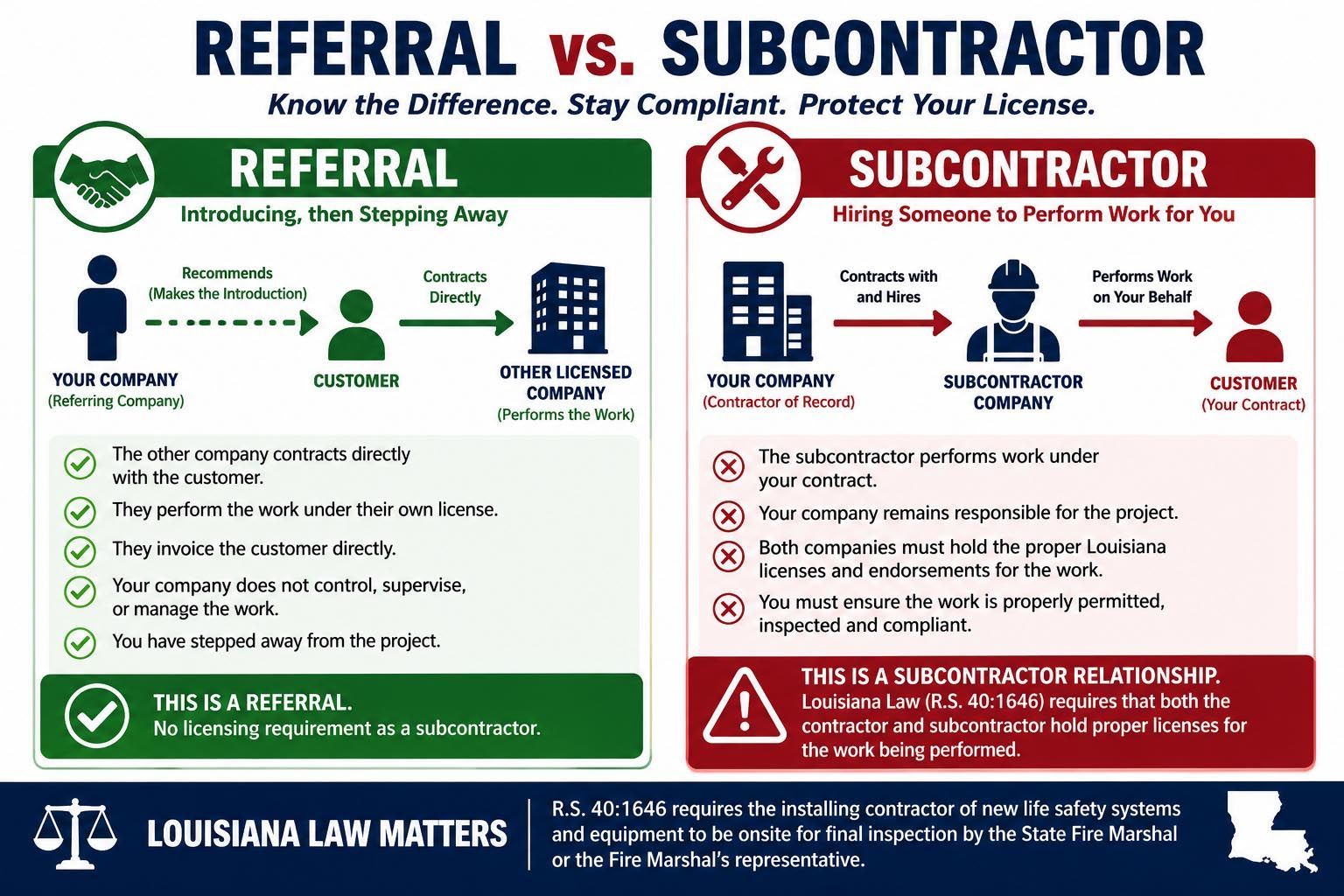
In Louisiana’s life safety and property protection industry, the words you use matter. One of the most misunderstood areas in the field is the difference between a “referral” and a “subcontractor.” Many companies casually use the terms interchangeably, but under Louisiana law, they are very different business relationships — and misunderstanding that difference can create licensing violations and liability concerns.
A referral occurs when one company simply recommends another licensed company to a customer and steps away from the project. The referred company contracts directly with the customer, performs the work under its own license, invoices the customer directly, and assumes responsibility for the installation or service. In this situation, the referring company is not managing the project, supervising the work, or representing the work as its own. A true referral is simply introducing the customer to another properly licensed provider.
A subcontractor relationship is very different. A subcontractor performs work on behalf of another company that holds the primary contract with the customer. In this arrangement, the hiring company remains responsible for the project and the subcontractor is working under that primary contract. This distinction becomes critical in Louisiana because companies cannot subcontract life safety and property protection work unless both parties hold the proper licenses and endorsements for the scope of work being performed.
Louisiana’s Life Safety and Property Protection Licensing Law defines “life safety and property protection contracting” broadly. Under R.S. 40:1664.3, the term includes installation, inspection, certification, integration, service, programming, testing, repair, and sales activities involving systems designed to protect life and property. Louisiana law further states that no person or firm may engage in this work without holding a valid license issued by the State Fire Marshal.
This means a company cannot avoid licensing requirements simply by labeling another company as a “subcontractor” while directing or controlling the work. If your company contracts a fire alarm installation, access control system, CCTV project, sprinkler work, or another regulated scope, both your company and the subcontracted company must hold the appropriate licenses and endorsements required for that work. Louisiana law also prohibits aiding or facilitating unlicensed activity.
R.S. 40:1646 also reinforces the importance of identifying the actual installing contractor. The statute specifically states that the installing contractor of new life safety systems and equipment must be onsite for final inspection by the State Fire Marshal or the Fire Marshal’s representative. That requirement highlights the state’s expectation that properly licensed contractors remain directly accountable for the work being performed.
Here is a simple way to think about the difference:
- Referral:
“You should call ABC Fire Protection. They handle that type of work.”
ABC contracts directly with the customer and performs the project independently. - Subcontractor:
“We sold the project and hired ABC Fire Protection to complete part of the installation for us.”
ABC is now performing work under your company’s contract and licensing requirements apply to both parties.
For Louisiana life safety and property protection companies, this distinction is more than semantics. It affects licensing compliance, liability exposure, inspections, insurance coverage, and consumer protection. Using the wrong structure — or simply using the wrong terminology — can create unnecessary risk during a State Fire Marshal investigation, project dispute, or licensing review.
The safest approach is simple: when referring work outside your licensed scope, make a true referral and allow the properly licensed company to contract directly with the customer. If you intend to subcontract regulated work, verify that every company involved holds the correct Louisiana licenses and endorsements before work begins.
For current licensing laws and regulations, members can review the Louisiana State Fire Marshal licensing resources at Louisiana State Fire Marshal Laws & Rules.
Legal and Regulatory Disclaimer
Information provided by LLSSA is for educational and informational purposes only and should not be considered legal advice or the official position of any regulatory agency or organization. Users should independently verify all information with the appropriate authorities and consult qualified legal counsel or other professionals regarding their specific circumstances.