Security Dealers Are Navigating a Changing Market — What It Means for Louisiana Integrators
The security and life-safety industry continues to demonstrate resilience, but it is also evolving quickly. New research from Parks Associates shows that dealers across North America are balancing strong long-term fundamentals with shifting customer expectations, technology disruption, and economic pressures.
For Louisiana contractors working in fire alarm, access control, video surveillance, and monitoring, these trends are not theoretical—they are already shaping how systems are designed, sold, installed, and serviced.
Strong Industry Fundamentals Remain in Place
Despite inflation concerns and tighter consumer spending, the security market remains stable. Installation activity has rebounded after pandemic disruptions, household system ownership is recovering, and demand for connected systems continues to grow.
This stability is important for companies operating under Louisiana’s Life Safety and Property Protection licensing structure. It confirms that professionally installed systems—and the technicians who support them—remain central to the security ecosystem.
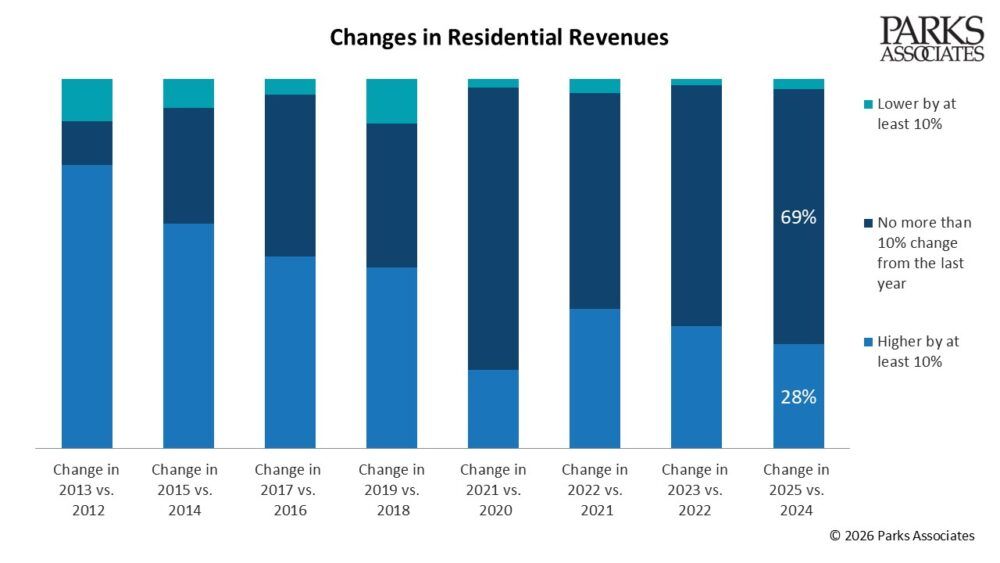
However, stability does not mean stagnation. Growth expectations have moderated compared to earlier years, with most dealers anticipating changes within about plus or minus ten percent annually rather than rapid expansion.
Video, AI, and Smart Devices Are Driving System Design
One of the most significant shifts across the industry is the move toward video-driven security platforms and AI-enabled services. Dealers are increasingly integrating analytics, smart home technologies, and automation into traditional intrusion systems.
For Louisiana integrators, this reinforces the importance of staying current on:
- video analytics platforms
- cloud-connected systems
- remote service capabilities
- hybrid intrusion/video deployments
Customers now expect systems that deliver intelligence—not just alarms.
DIY Competition Is Real—but Professional Installation Still Matters
DIY security continues to expand, creating competitive pressure in the residential market. At the same time, the research confirms that professional dealers remain essential because they provide system integration, monitoring reliability, compliance expertise, and lifecycle service support.
This is especially true in Louisiana, where licensing requirements help preserve professional standards and protect consumers.
Companies that emphasize code compliance, monitoring partnerships, and long-term service relationships maintain a clear advantage over retail-driven alternatives.
Commercial Security Is Becoming a Major Growth Engine
Across the dealer channel, diversification into commercial work is one of the most important strategies for maintaining revenue growth. Many companies are expanding services beyond residential intrusion into access control, video surveillance, and integrated systems.
For LLSSA members, this aligns directly with opportunities in:
- schools and campuses
- healthcare facilities
- industrial environments
- critical infrastructure
- municipal and parish projects
Commercial expansion also strengthens recurring monitoring revenue and service agreements.
Digital Sales and Automation Are Reshaping Operations
Another key trend is operational modernization. Dealers are increasingly using digital tools for proposals, scheduling, remote diagnostics, and customer engagement.
These efficiencies help address one of the industry’s biggest challenges: workforce availability. Companies that streamline workflows can scale more effectively without increasing overhead at the same rate.
Consolidation Continues Across the Industry
Investment activity and acquisitions remain common as larger organizations pursue scale in what is still a fragmented market.
Independent dealers remain competitive by focusing on:
- local relationships
- service responsiveness
- code expertise
- regional knowledge
- association involvement
This is where organizations like LLSSA play a critical role in strengthening the voice of locally owned companies.
Why This Matters for Louisiana Professionals
The takeaway from this research is clear: the dealer channel remains strong, but success depends on adaptation.
Companies that invest in training, embrace emerging technologies, expand commercial capabilities, and stay engaged with their state association will be best positioned to grow in the years ahead.
Louisiana’s licensing framework already sets a high professional standard. Staying connected through LLSSA ensures that integrators not only keep pace with industry change—but help shape the future of the life-safety and property-protection profession in our state.
Legal and Regulatory Disclaimer
Information provided by LLSSA is for educational and informational purposes only and should not be considered legal advice or the official position of any regulatory agency or organization. Users should independently verify all information with the appropriate authorities and consult qualified legal counsel or other professionals regarding their specific circumstances.