
Understanding Louisiana’s Fire Protection Tags: White, Green, Yellow, and Red
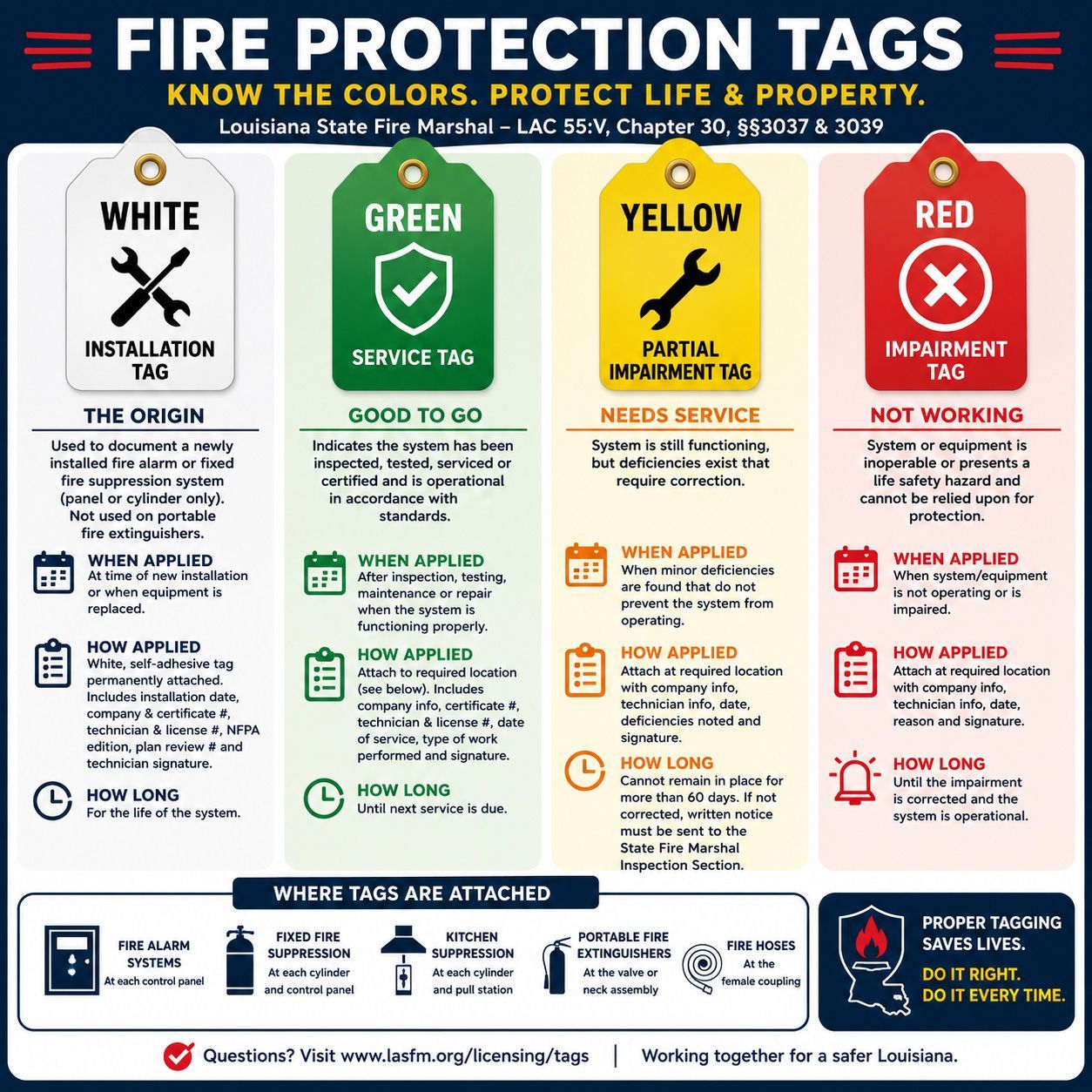
In Louisiana, fire protection tags are more than just colored pieces of paper attached to equipment. They are an important communication tool required by the Louisiana State Fire Marshal’s Office (SFMO) and help building owners, inspectors, technicians, and responding fire departments quickly understand the condition of a fire protection system or piece of equipment. Under LAC 55:V Chapter 30, Sections 3037 and 3039, the State Fire Marshal establishes specific requirements for installation tags, service tags, partial impairment tags, and impairment tags.
The color system is simple and effective: white means newly installed, green means operational and “good to go,” yellow means the system still works but needs attention, and red means the equipment or system is impaired and cannot be relied upon for life safety protection. Understanding the purpose and proper use of each tag is critical for every Louisiana life safety and property protection professional.
White Tags – The Origin of the System
The white tag is the installation tag and represents the beginning of a system’s life. Louisiana requires that every newly installed fire alarm system or fixed fire suppression system have a white installation tag permanently affixed to the system panel or suppression cylinder. Portable fire extinguishers are specifically excluded from this requirement.
The installation tag must be white, self-adhesive, and permanently attached to the fire alarm control panel or suppression cylinder. It documents important information including the installation date, the installing company’s name and certificate number, the technician’s name and license number, the NFPA code edition used for the installation, and the applicable plan review number. The technician must personally sign the tag — initials and preprinted signatures are not allowed.
Think of the white tag as the “birth certificate” of the system. It establishes when the system was installed and who performed the work. If a control panel or suppression cylinder is later replaced, a new installation tag must be attached and marked as a replacement. The white tag remains with the equipment for the life of the installation and provides a permanent historical reference for inspectors, service technicians, and owners.
Green Tags – Good to Go
Green tags are the most commonly recognized service tags in Louisiana. For fire alarm and fixed fire suppression systems, service tags are required to be green in color. These tags indicate the system has been inspected, tested, serviced, or certified and was found to be operational in accordance with the applicable NFPA standards at the time of service.
A green tag is attached after a system has been properly inspected or serviced and found to be functioning as intended. This includes new installations, annual inspections, six-month inspections, maintenance visits, and repair work where the system is returned to operational condition. The tag communicates that the system is currently “good to go.”
The State Fire Marshal’s rules specify exactly where tags must be attached:
- Fire alarm systems: at each control panel
- Fixed fire suppression systems: at each cylinder and control panel
- Kitchen suppression systems: at each cylinder and pull station
- Portable extinguishers: at the valve or neck assembly
- Fire hoses: at the female coupling
Each green service tag must include the servicing firm’s name, address, phone number, certificate number, technician name and license number, date of service, and type of work performed. The technician must sign the tag at the time of service.
For installers and service companies, the green tag is a visible representation of compliance, professionalism, and completed work.
Yellow Tags – Needs Service but Still Functional
Yellow tags are officially called “Partial Impairment Tags” under Louisiana regulations. A yellow tag means the system is still functioning, but deficiencies exist that require correction.
This is commonly used when minor issues are discovered during inspection or service. Examples might include:
- A fire alarm system that is operational but lacks required off-site monitoring
- A suppression system with minor components needing replacement
- Routine maintenance recommended but not yet authorized by the owner
- Deficiencies that do not prevent the system from operating, but still need correction
The yellow tag serves as a warning that the system is not fully compliant or fully maintained, even though it still provides some level of protection. Importantly, Louisiana rules state that a yellow tag cannot remain on a system for more than 60 days. If the deficiency is not corrected within that time, the servicing firm must notify the State Fire Marshal Inspection Section in writing.
Yellow tags are an important tool because they create documentation and accountability without immediately declaring a system out of service. They also protect the servicing company by documenting that deficiencies were identified and communicated to the owner.
Red Tags – Not Working or Unsafe
Red tags are impairment tags and represent the most serious condition. A red tag means the system or equipment is impaired to the point that it cannot be relied upon for life safety protection.
For fire alarm and suppression systems, a red tag must be placed when a condition exists that prevents the system from operating as intended or places life safety at risk. Portable fire extinguishers must be red tagged whenever they are inoperable for any reason.
Examples of red tag conditions may include:
- Fire alarm panels with major faults or disabled functions
- Suppression systems incapable of discharge
- Inoperable pull stations
- Empty or discharged extinguishers
- Damaged or failed components that prevent proper operation
- Systems presenting an imminent life safety hazard
Unlike yellow tags, red tags require immediate action. The servicing firm must notify both the owner and the State Fire Marshal Inspection Section as soon as practical, but no later than two working days after the tag is applied. Additional notification to the local fire department is also recommended.
A red tag is not simply paperwork — it is a clear declaration that the system is not protecting the building as intended. Building owners should treat red-tagged systems as urgent life safety issues requiring immediate repair or replacement.
Why the Tag System Matters
Louisiana’s tagging requirements create consistency across the life safety industry and provide immediate visual communication about system status. Whether it is a white installation tag documenting the origin of a system, a green tag confirming operational readiness, a yellow tag warning of needed repairs, or a red tag identifying a serious impairment, these tags help ensure transparency, accountability, and protection of lives and property across the state.
For licensed firms and technicians, proper tagging is not optional. It is part of professional compliance with State Fire Marshal regulations and an important record of the work performed. When used correctly, the tag system helps owners understand the condition of their fire protection systems and supports safer buildings throughout Louisiana.
Legal and Regulatory Disclaimer
Information provided by LLSSA is for educational and informational purposes only and should not be considered legal advice or the official position of any regulatory agency or organization. Users should independently verify all information with the appropriate authorities and consult qualified legal counsel or other professionals regarding their specific circumstances.