From Classroom to Career: Building Louisiana’s Next Generation of Life Safety Technicians
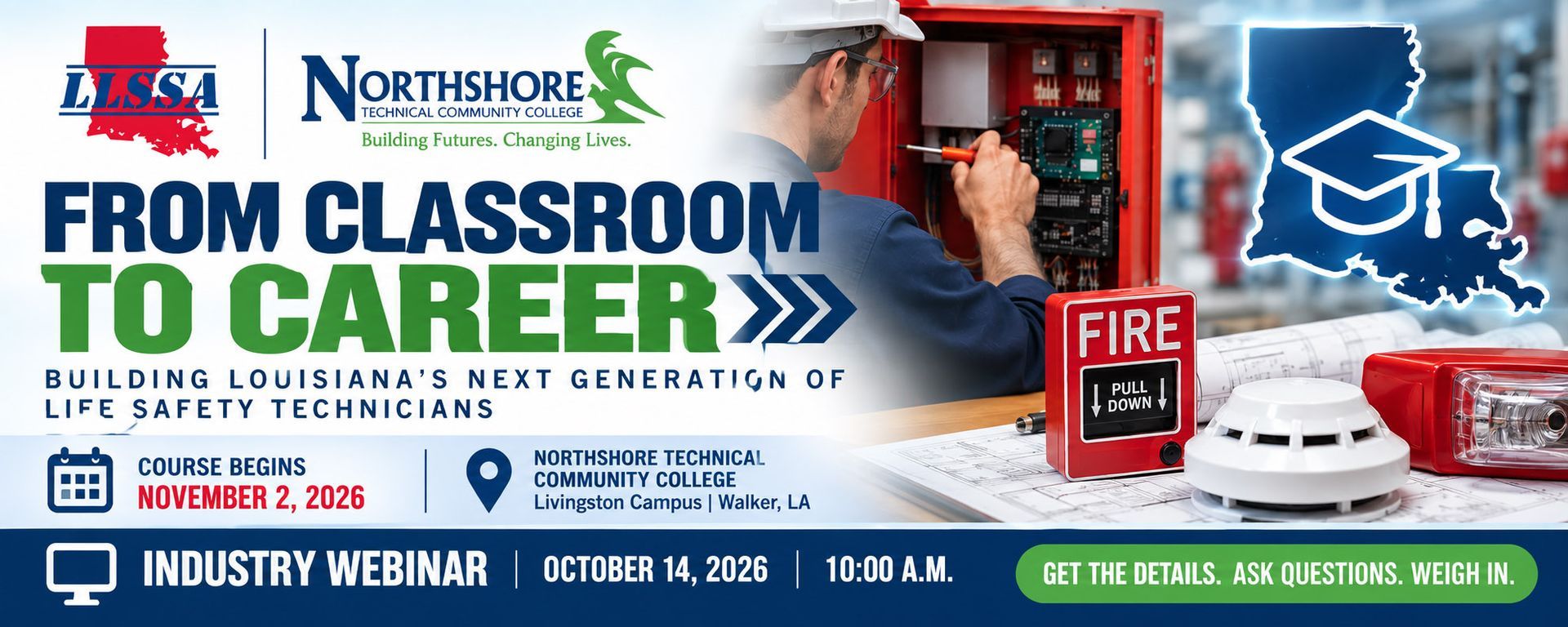
The Louisiana Life Safety & Security Association (LLSSA) is partnering with Northshore Technical Community College (NTCC) to create a new pathway into Louisiana’s life safety and property protection industry. Beginning November 2, 2026, NTCC will offer the Life Safety Alarm Course at its Livingston Campus in Walker, giving students an opportunity to receive industry-focused training taught by experienced LLSSA instructors.
For Louisiana alarm companies, this partnership addresses one of the industry’s most persistent challenges: finding qualified people who are prepared to enter the workforce. Rather than hiring someone with little or no industry background and beginning the entire training process from scratch, employers will have the opportunity to recruit graduates who have already completed structured training in the fundamentals of life safety alarm systems.
The three-week course will meet Mondays and Wednesdays from 5:00–9:00 p.m. at Northshore Technical Community College’s Livingston Campus. The curriculum introduces students to fire and alarm system fundamentals, applicable codes and standards, initiating devices, circuits and pathways, controls and command centers, power supplies, notification appliances, signaling systems, special systems, false alarm reduction, documentation, and system approvals and acceptance. The curriculum also emphasizes inspection, testing, documentation, and acceptance requirements—important responsibilities technicians encounter in the field.
Most importantly for employers, the program is designed to do more than introduce students to the industry. Students who successfully complete the program will receive the course certificate needed to meet the applicable training requirement for Louisiana licensure. That means graduates can leave the program with a significant part of the licensing preparation already completed and be positioned to enter the workforce rather than requiring an employer to first locate and arrange the required classroom training.
This creates a valuable recruiting opportunity for Louisiana life safety and property protection companies. Employers need technicians who understand not only how equipment is installed, but also why systems must be installed, programmed, tested, documented, and maintained correctly. The course exposes students to subjects they will encounter on actual installations, including fire alarm control units, power supplies, system signaling, emergency control functions, and other critical system components.
The partnership also creates an opportunity for existing companies to develop employees already on their teams. A company may have an apprentice, helper, electrician, low-voltage employee, or other promising individual who wants to advance into life safety alarm work. Sending that employee through the NTCC program provides a structured educational pathway while allowing the employer to continue developing the hands-on skills that come from field experience.
Before the first class begins, LLSSA will host a special webinar on Wednesday, October 14, at 10:00 a.m. for Louisiana life safety and property protection professionals. This is an opportunity for installers, company owners, managers, technicians, and others in the industry to get the full details about the new program, ask questions, and weigh in on how the program can best serve Louisiana employers and the industry.
If your company needs technicians, is looking for a better way to train new employees, or simply wants to understand how this new partnership can help build Louisiana’s future workforce, we strongly encourage you to attend the webinar. Industry participation is important. The program is intended to create a pipeline between the classroom and Louisiana employers, and input from the companies that will ultimately hire and develop these graduates can help make that pipeline stronger.
The webinar will also give employers an opportunity to learn how they can support the program, promote it to prospective students, identify potential employees for training, and become involved as the partnership grows. Mark your calendar for October 14 at 10:00 a.m. and be part of the conversation.
For LLSSA, the program represents an investment in the future of Louisiana’s industry. As experienced technicians retire and companies continue to compete for skilled employees, developing new technicians cannot be left to chance. Bringing industry-developed training into a community college environment introduces life safety and property protection careers to people who may never have considered the profession while creating a more direct connection between education, licensing, and employment.
Scholarships are available for Louisiana residents, and seating is limited. LLSSA members and other Louisiana life safety and property protection companies are encouraged to share the program with prospective employees, current staff members who need training, and individuals in their communities who may be looking for a new technical career.
The first class begins November 2, 2026, at Northshore Technical Community College’s Livingston Campus in Walker. Those interested should complete the program interest form as soon as possible. For questions about the course, contact Northshore Technical Community College at 985-545-1667.
For Louisiana alarm companies, the goal is straightforward: train people, help them obtain the credentials necessary to become licensed, and create a pipeline of new technicians ready to go to work protecting Louisiana’s homes, businesses, and communities.
But first, join us October 14 at 10:00 a.m. Learn about the program, ask your questions, share your perspective, and help LLSSA and Northshore Technical Community College build a training program that works for Louisiana’s life safety industry.
Legal and Regulatory Disclaimer
Information provided by LLSSA is for educational and informational purposes only and should not be considered legal advice or the official position of any regulatory agency or organization. Users should independently verify all information with the appropriate authorities and consult qualified legal counsel or other professionals regarding their specific circumstances.