
The Danger of Ghost Devices
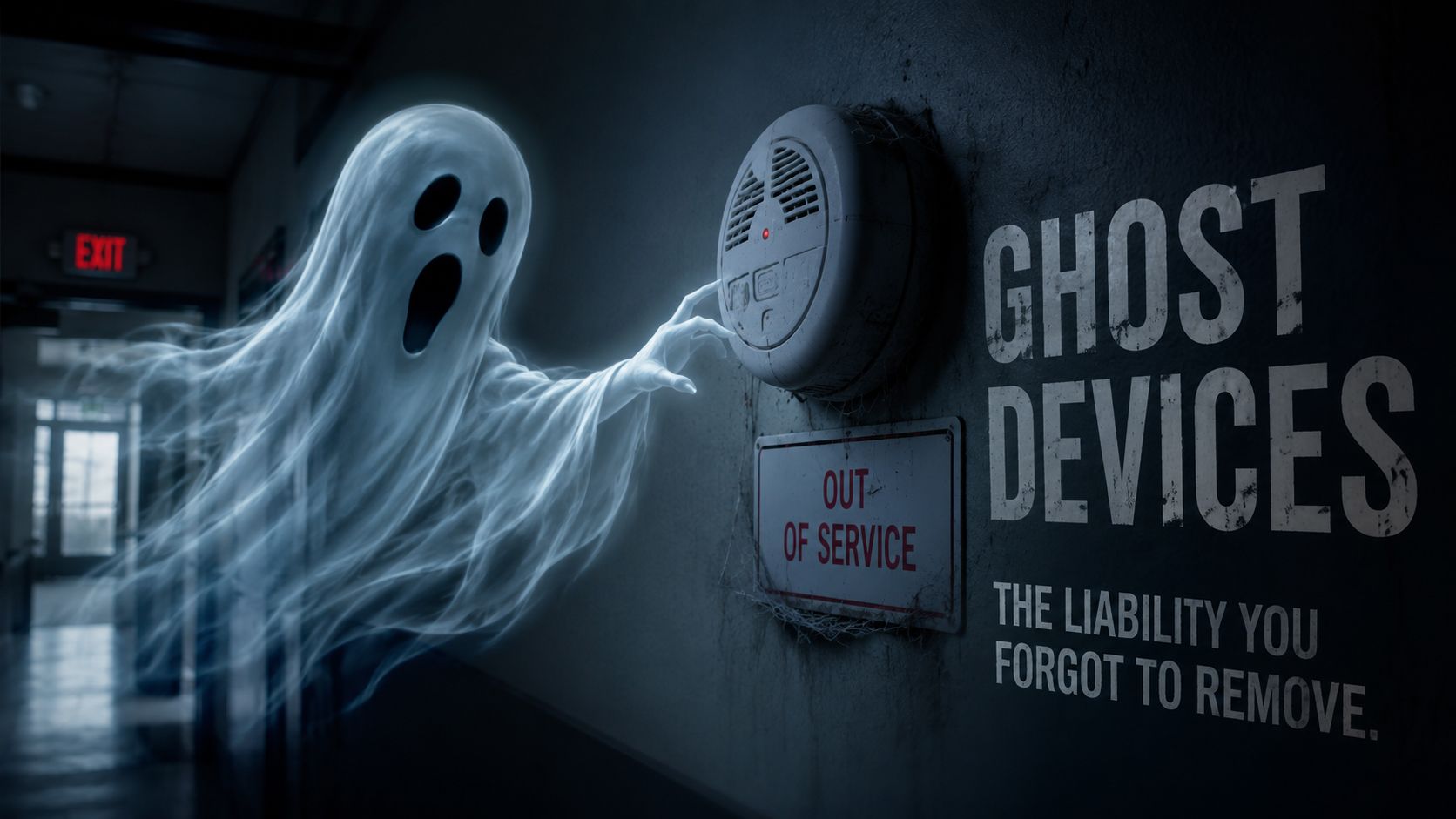
One of the most overlooked sources of liability in the life safety and property protection industry is not a defective device or a poor installation—it is the device that no longer works but is still hanging on the wall, ceiling, or door where the public reasonably believes it is protecting them. Whether it is an abandoned smoke detector, a disconnected motion detector, an old panic button, a non-functional pull station, a camera that no longer records, or an access control reader that has been bypassed, leaving inactive equipment in place can create significant legal exposure for both the installing company and the property owner.
The legal issue centers on what courts often recognize as the "reasonable expectation" or "reasonable reliance" of an ordinary person. When someone walks into a building and sees what appears to be a functioning life safety or security device, they generally assume it is operational unless clearly marked otherwise. Occupants, employees, visitors, first responders, and even insurance investigators frequently rely on the visible presence of these devices when determining whether reasonable protection existed. If an emergency occurs and it is discovered that the device had been disconnected months or years earlier but was left in place without any indication that it was no longer functional, questions quickly arise about who made that decision and whether it created a dangerous condition.
Louisiana law, like the law in most states, recognizes negligence when a party owes a duty, breaches that duty, and that breach contributes to damages. Courts routinely evaluate whether a contractor acted as a reasonably prudent professional under similar circumstances. While no Louisiana statute specifically states that every abandoned alarm device must be removed, Louisiana Civil Code Article 2315 establishes the general obligation that every act causing damage through fault may obligate the responsible party to repair that damage. If an installer knowingly leaves non-functioning equipment where occupants are likely to believe it provides protection, plaintiffs may argue that the installer created or contributed to a misleading and hazardous condition.
Nationally, these claims are often based on theories of negligence, negligent misrepresentation, assumption of duty, or premises liability. Once a company undertakes work involving life safety systems, courts may examine whether its actions increased the risk of harm or created a false sense of security. Plaintiffs' attorneys frequently argue that visible but non-operational devices caused occupants to delay evacuation, assume an area was protected, or believe emergency notification would occur when it would not.
Several well-known lawsuits throughout the alarm and fire protection industries illustrate how expensive these arguments can become. Although many cases ultimately settle before trial and confidentiality agreements prevent disclosure of details, litigation has repeatedly focused on whether installers properly documented impairments, removed obsolete equipment, informed customers of deficiencies, or allowed misleading conditions to remain. Courts have consistently allowed negligence claims to proceed when plaintiffs present evidence that an installer's actions or omissions may have contributed to an occupant's belief that protection existed.
Even Louisiana courts have demonstrated a willingness to examine an installer's continuing responsibility for alarm equipment after installation. In Rosalee, Inc. v. All Safe Alarms, L.L.C. the Louisiana First Circuit Court of Appeal held that allegations involving an alarm company's continued maintenance of an alarm system after receiving notice of a dispute were sufficient for the litigation to continue rather than being dismissed at an early stage. While the case involved property access rather than life safety, it reinforces an important principle: installers can remain exposed to liability based on their continuing involvement with installed equipment, not merely the original installation itself.
Fire alarm systems present an even greater concern. NFPA codes require impairments to be properly managed and documented because life safety systems are expected to operate when needed. Leaving disconnected initiating devices, notification appliances, or other obsolete components visible after system modifications can confuse occupants, inspectors, and emergency responders during an emergency. Even in the security industry, abandoned cameras, access readers, keypads, panic buttons, or intrusion devices can create the appearance of protection that no longer exists. When those devices fail to perform because they are no longer connected, plaintiffs may argue that the visible presence of the equipment itself contributed to the loss.
The safest practice is straightforward. Whenever equipment is permanently removed from service, it should also be physically removed whenever practical. If immediate removal is not possible, it should be clearly identified as out of service, documented in writing, disclosed to the property owner, and scheduled for removal as part of the project. Service tickets, deficiency reports, photographs, customer acknowledgements, and updated as-built drawings should all reflect the change. If the customer refuses removal, that refusal should be documented with a signed acknowledgment that identifies the device, confirms it is not operational, and explains that its continued presence may create confusion regarding the level of protection provided.
Installers should also educate customers that leaving abandoned devices in place is not simply an aesthetic issue. It may affect insurance claims, code inspections, future service work, emergency response, and civil litigation. A device that no longer functions but still appears active can become a key exhibit in a courtroom after a fire, burglary, assault, or other catastrophic event.
The best liability defense is not simply installing systems correctly—it is ensuring that what people see accurately reflects the protection they actually have. Removing obsolete equipment, documenting deficiencies, and refusing to leave behind "ghost devices" protects the customer, the occupants, and ultimately the installer. In the life safety and property protection industry, appearances matter. If a device looks like it should save a life or summon help, a jury may very well expect that it would have.
Legal and Regulatory Disclaimer
Information provided by LLSSA is for educational and informational purposes only and should not be considered legal advice or the official position of any regulatory agency or organization. Users should independently verify all information with the appropriate authorities and consult qualified legal counsel or other professionals regarding their specific circumstances.