The Last Step That Matters Most: Applying Louisiana Service Tags Correctly
In Louisiana, a service tag is much more than a maintenance record—it is a legal document that demonstrates a licensed company has performed work on a regulated life safety or property protection system. The Louisiana Life Safety and Property Protection Licensing Act makes it clear that the State Fire Marshal regulates the certification, inspection, installation, integration, sale, and servicing of these systems and prohibits the use of systems that are not properly labeled in accordance with the rules adopted by the State Fire Marshal. Whether the work involves a fire alarm panel, a portable fire extinguisher, a sprinkler system, a kitchen suppression system, or a special locking system, the service tag is one of the first items an inspector, Authority Having Jurisdiction (AHJ), insurance representative, or attorney will examine following an inspection or incident.
Louisiana Revised Statute R.S. 40:1664.2 establishes that life safety and property protection systems must be properly labeled in accordance with rules adopted by the State Fire Marshal, while R.S. 40:1646 requires life safety systems and equipment to be inspected, certified, and tested and identifies the systems covered by the law, including fire sprinkler systems, fire alarm systems, fire suppression systems, special locking systems and equipment, portable fire extinguishers, and conveyance devices. These statutes are implemented through the Louisiana Administrative Code, Title 55, Chapters 30, 31, and 32, which contain the detailed requirements for installation tags, service tags, impairment tags, placards, and related marking requirements for regulated systems.
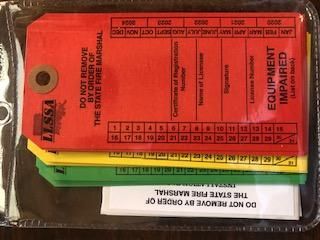
For fire detection and alarm systems, fixed fire suppression systems, portable fire extinguishers, fire hoses, and related fire protection equipment, the requirements for installation tags are found in LAC 55:V.3037, while service tags, yellow tags, red tags, and stenciling are governed by LAC 55:V.3039. These provisions apply whenever regulated work is performed, including installation, inspection, certification, maintenance, repair, recharge, hydrostatic testing where applicable, or other servicing required by the applicable NFPA standard.
Fire sprinkler systems and associated equipment have similar requirements. LAC 55:V.3133 governs installation placards, while LAC 55:V.3135 establishes the requirements for service tags, yellow tags, red tags, and stenciling. These placards and tags document the work performed on sprinkler systems, standpipe systems, fire pumps, hose stations, and related equipment and provide inspectors with an immediate history of the system's maintenance status.
Property protection systems regulated under Chapter 32—including intrusion alarm systems, access control systems, CCTV systems, household fire warning systems, and special locking systems—also have mandatory tagging requirements. LAC 55:V.3235 addresses installation tags, while LAC 55:V.3237 governs certification tags, service tags, and, for special locking systems, partial impairment and impairment tags. These tags identify the licensed firm responsible for the work and document the status of the protected system whenever installation, certification, inspection, or service is completed.
Although the specific placement varies by equipment type and applicable NFPA standard, the State Fire Marshal's rules consistently require that tags be attached directly to the equipment or system being serviced in a conspicuous and readily accessible location where they can be examined without disassembly. On a fire alarm system, this is commonly at the control unit or other designated system component. On portable fire extinguishers, the tag is attached through the carrying handle. Fire sprinkler systems use installation placards and inspection documentation located at or near the riser assembly, while suppression systems are tagged at the protected equipment or releasing control equipment. Special locking systems must have the appropriate certification or service tag attached to the regulated locking equipment in accordance with Chapter 32 and the applicable installation standards.
Technicians should also understand that service tags are required each time regulated service is performed, not simply during annual inspections. Any inspection, certification, repair, replacement, testing, maintenance, recharge, or other service that falls within the scope of Louisiana's licensing laws requires the appropriate tag to accurately reflect the current condition of the equipment. Likewise, when a system is found to be impaired or only partially operational, the appropriate impairment tag must be used where required by the administrative rules so building owners, inspectors, and responding authorities are immediately aware of the system's condition.
For technicians, properly completing and attaching a service tag is just as important as performing the work itself. A missing, incomplete, or improperly placed tag can raise questions about whether the inspection or service was actually performed and may expose both the technician and the licensed firm to regulatory action. In the event of a fire, burglary, or other loss, the service tag often becomes part of the official record reviewed by investigators, insurance companies, and attorneys. It demonstrates who performed the work, when it was completed, and whether the equipment was left in service, impaired, or requiring additional corrective action.
The best practice is simple: every regulated system that is installed, inspected, certified, or serviced under Louisiana law should leave the job with the correct State Fire Marshal-approved tag, fully completed, securely attached in the proper location, and legible for the life of the service interval. Taking a few extra moments to ensure the tag is accurate protects the customer, assists inspectors, demonstrates compliance with Louisiana law, and protects your company should questions ever arise about the work that was performed.
Legal and Regulatory Disclaimer
Information provided by LLSSA is for educational and informational purposes only and should not be considered legal advice or the official position of any regulatory agency or organization. Users should independently verify all information with the appropriate authorities and consult qualified legal counsel or other professionals regarding their specific circumstances.