
Where the Wire Ends: Electrical Contractors and Louisiana LSPP Licensing
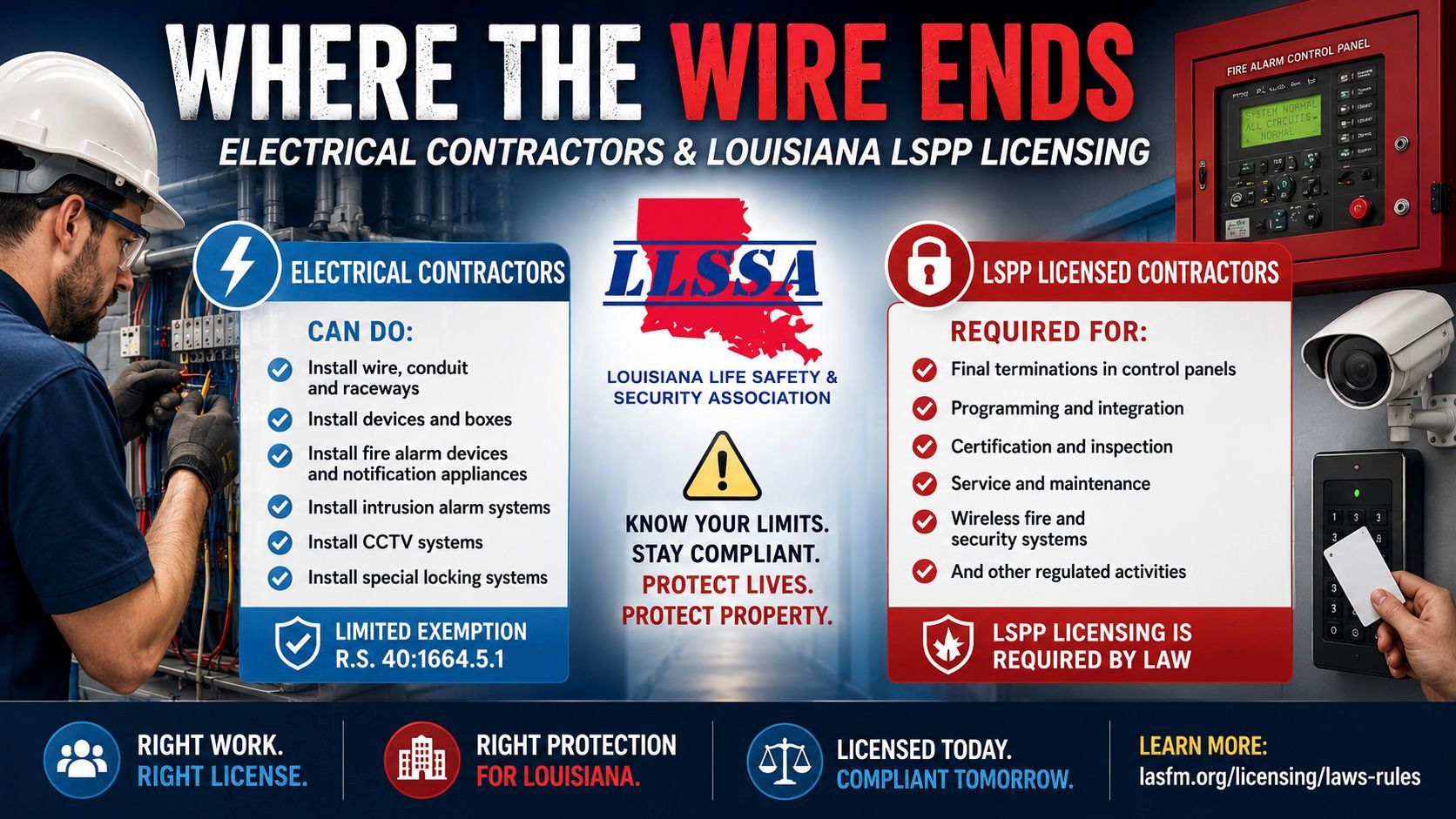
Electrical contractors and life safety and property protection contractors often work side by side on the same project. A fire alarm system needs wiring. A security system needs power and cabling. Access control and special locking systems involve electrical components. Cameras require cabling and connections. Because the work overlaps, it can be easy to assume that an electrical contractor's license automatically authorizes the contractor to perform every part of these systems.
Louisiana law draws a much more specific line between electrical work and licensed Life Safety and Property Protection (LSPP) work. Understanding that line is important for electrical contractors as well as fire alarm, security, access control and CCTV companies that may be working with them on the same project.
The starting point is Louisiana Revised Statute 40:1664.5.1, which establishes a **limited exemption from LSPP licensure for electrical contractors**. The statute applies to a firm or person holding the classification of **Electrical Work (Statewide)** through the Louisiana State Licensing Board for Contractors. Under that exemption, the electrical contractor may install wire, conduit and other wire raceways, associated boxes and fittings, as well as certain devices and systems, without obtaining an LSPP license from the Louisiana State Fire Marshal.
The systems covered by the exemption include fire alarm initiating and notification devices, intrusion alarm systems, closed circuit television systems and special locking systems in commercial or residential property. In practical terms, a properly licensed statewide electrical contractor can perform a significant amount of the physical installation associated with these systems. However, the exemption does not turn the electrical contractor into a licensed fire alarm, security, CCTV or special locking contractor.
One of the most important limitations concerns **final termination**. R.S. 40:1664.5.1 specifically states that the electrical contractor's exempt work does not include final termination in a fire alarm control panel, security control panel, access control panel or CCTV system controls. Those final terminations must be performed by a firm and an individual holding the appropriate valid LSPP licenses.
This distinction is especially important on fire alarm projects. Chapter 30 of the Louisiana Administrative Code similarly states that electrical contractors are limited to installation of wiring, conduit raceways and/or devices for fire detection and alarm systems, while connections or final terminations within the alarm control panel must be made by licensed employees of the fire detection and alarm firm. The rules also reserve certifying, inspecting, integrating, maintaining and servicing a fire detection and alarm system to properly certified fire alarm firms and their licensed employees.
The law places another clear restriction on electrical contractors: **they may not certify, inspect or service life safety and property protection systems or equipment under the electrical-contractor exemption.** Those activities require the appropriate LSPP licensing. This means that completing physical installation work that falls within the exemption is different from assuming responsibility for the completed system, inspecting it for compliance, certifying it or returning later to perform service work.
Wireless systems are another important limitation. The statute expressly says that the electrical-contractor exemption does **not** apply to a person or entity selling, installing, servicing or maintaining wireless security and fire systems. An electrical license should therefore not be viewed as a general authorization to enter the wireless alarm business without the applicable LSPP credentials.
Special locking systems deserve particular attention because they affect building egress and life safety. Chapter 32 requires plans for applicable new or renovated special locking systems to be submitted to and reviewed by the State Fire Marshal before installation. The rules also provide that the completed system must be certified by a property protection contractor, and an electrical contractor is not permitted to certify, inspect or service the special locking system.
The plan-review requirements can also affect when work begins. Chapter 32 provides that when a special locking system requires plan submittal, system locks, devices and panels cannot be installed before the required review or written authorization. Wiring-only work may begin after plans have been received and a project review number has been issued, as provided by the rule.
Fire sprinkler systems present another boundary. The electrical-contractor exemption in R.S. 40:1664.5.1 does not provide authority to perform fire sprinkler contracting. Chapter 31 requires regulated sprinkler work to be performed within the applicable sprinkler licensing requirements. It also specifically addresses alarm devices associated with sprinkler piping: devices such as flow switches, pressure switches and low-air-pressure switches that are integral to the piping system are installed by the certified fire sprinkler contractor and connected to the fire alarm system by a certified fire detection and alarm firm.
The licensing question therefore depends not simply on whether electricity is involved, but on **what activity is actually being performed**. Louisiana law defines life safety and property protection contracting broadly to include certification, inspection, installation, integration, programming, sale and service of systems designed to protect life and property. It also encompasses activities such as prewiring, construction, maintenance, repair, testing, modification and alteration. The electrical-contractor exemption carves out specific installation activities from those requirements; it does not remove the remainder of the LSPP law.
This is also why an electrical contractor that wants to go beyond the limited exemption needs to look at LSPP licensing separately. If a company intends to perform activities requiring an LSPP license—such as final control-panel terminations, certification, inspection or service—it must obtain the applicable firm licensing and endorsements and use appropriately licensed personnel. Louisiana law requires a firm engaged in LSPP contracting to obtain a license for each operating location and for each discipline in which it performs regulated work. Among the firm requirements are appropriate insurance and employment of a qualifying individual with the required certification and training for each endorsement held.
There is one point contractors should be particularly careful about when reading the regulations online. Some provisions of Chapters 30 and 32 were written before the current statutory limited exemption and contain language describing electrical-contractor authority somewhat differently. The State Fire Marshal's own Laws & Rules page currently cautions that the regulations posted there are under review and revision and may not be current, and directs licensing questions to the Licensing Division for clarification. ([Louisiana Office of State Fire Marshal][1]) Contractors should therefore review the current statute—particularly R.S. 40:1664.5.1—along with the applicable administrative rule rather than relying on one provision in isolation.
For installers, the safest way to think about the distinction is straightforward: **an electrical license and an LSPP license authorize different scopes of work.** A qualifying statewide electrical contractor has a limited statutory exemption that allows specified installation work on certain life safety and property protection systems. It does not provide blanket authority to perform everything associated with those systems. Final control-panel terminations, certification, inspection, service and other regulated activities remain within the appropriately licensed LSPP disciplines, and wireless fire and security systems are specifically outside the electrical-contractor exemption.
Before accepting a project that approaches the boundary between electrical and LSPP work, contractors should identify exactly who will install the equipment, who will make the final control-panel terminations, who will perform any required programming or integration, and who will inspect, service and certify the finished system. Establishing those responsibilities before work begins can prevent licensing problems, project delays and disputes at final inspection.
The Louisiana Office of State Fire Marshal maintains the applicable statutes and administrative rules on its [Life Safety and Property Protection Laws & Rules page](https://www.lasfm.org/licensing/laws-rules/?utm_source=chatgpt.com). Because the State Fire Marshal notes that some posted regulations are currently under review and revision, contractors with questions about whether a particular task falls within the electrical-contractor exemption should contact the OSFM Licensing Division for clarification before performing the work.
Legal and Regulatory Disclaimer
Information provided by LLSSA is for educational and informational purposes only and should not be considered legal advice or the official position of any regulatory agency or organization. Users should independently verify all information with the appropriate authorities and consult qualified legal counsel or other professionals regarding their specific circumstances.